
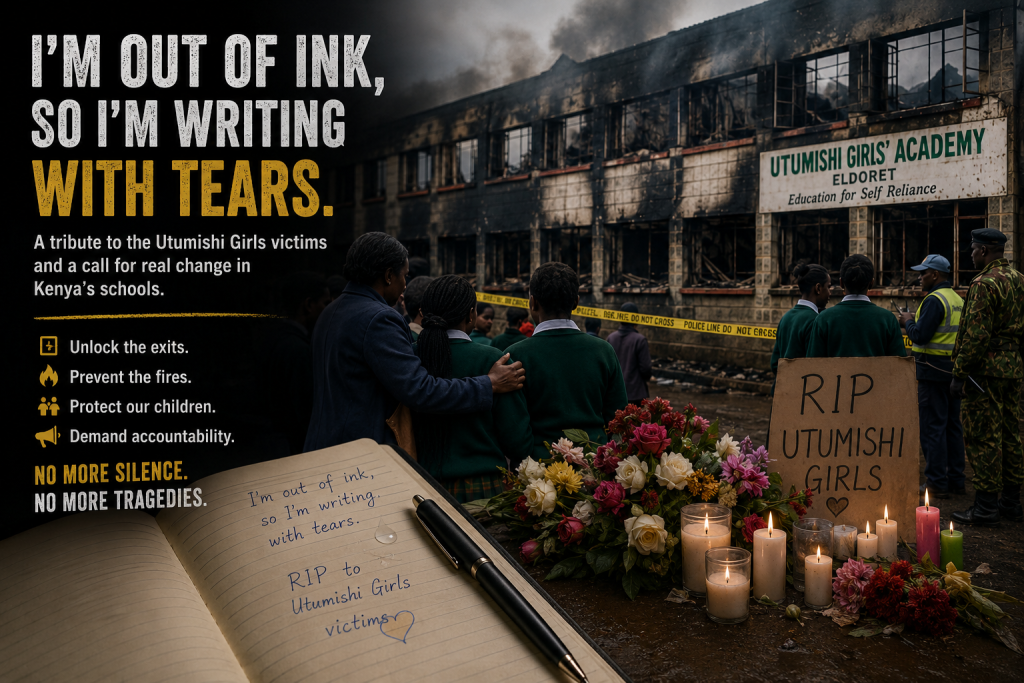
RIP to the Utumishi Girls victims.
Some tragedies hit differently. Not because they are new, but because they feel painfully familiar. The Utumishi Girls fire tragedy is one of those moments. A moment that has left parents broken, students traumatized, and the country once again asking the same questions we have asked for years.
The saddest part is that almost everything being said today is true. Unfortunately, many Kenyans already know how this story usually ends. A committee will be formed. Statements will be issued. Headlines will slowly disappear. Money meant to help will be misused somewhere along the way. Families will be frustrated by endless processes. And before long, this tragedy risks becoming just another painful chapter we only remember during the next disaster.
But for some of us, this story is personal.
I am an alumnus of Isibania Boys High School. Between 2008 and 2011, we experienced two attempted arson attacks and one successful fire incident that completely destroyed a dormitory and everything inside it. By pure luck, no lives were lost. The fire happened about thirty minutes before evening remedials ended. Had students been inside, we would probably be telling a very different story today.
Police officers, teachers, and local residents came to help. Suspected students were arrested. The following morning, we were sent home.
When we later returned to school, I remember seeing our principal, Mr. Mirumbe, seated quietly outside his teachers’ quarters. He was a good man. Many students respected him deeply, so some of us walked over to greet him.
What started as a simple greeting slowly became a gathering. Before we knew it, students had formed a small crowd around him. That day, he spoke to us not just as a principal, but as a father figure carrying pain too heavy to hide.
He told us how heartbroken he was. After years of hard work rising through the education system to become the principal of a provincial school, he was now being transferred and demoted to a much smaller school because of the fire incident. He asked us one painful question:
“Where did I go wrong?”
Then he cried.
Not the kind of tears people fake. He cried deeply, openly, like a man whose spirit had been crushed. As young students, many of us did not fully understand the weight he was carrying. But today, looking back, I understand it better.
He loved that school. He loved the students. But somewhere between school politics, fear, punishment systems, poor communication, and institutional failures, the relationship between administration and learners had broken down.
That disconnect is still killing our schools today.
During our time, one failed arson attempt could easily have become a national tragedy. We had a huge dormitory called Cardinal Otunga. It was so long you could get tired walking from one end to the other. It had only two doors at opposite ends, and one of them was locked most of the time. The windows had metal grills reinforced with wire mesh.
We nicknamed it “Mortuary.”
Looking back now, that name was not even a joke. It was a warning.
The only reason disaster was avoided was because students, teachers, administrators, and police officers acted quickly together. There was coordination. There was urgency.
Anyone who has studied in a Kenyan boarding school knows there are periods when tension rises. Before and after mock exams especially, students remain idle for days while teachers mark papers. Stress increases. Rumours spread. Anger builds quietly. If school administrations are not alert during such moments, disaster can easily brew in silence.
What hurts is realizing that more than twenty years later, some schools still have the same dangerous conditions. Overcrowded dormitories. Locked exits. Poor emergency preparation. Weak student counselling. Fear-based leadership. Broken communication between students and school administrations.
The Utumishi Girls tragedy did not happen because nobody knew the risks. We have known these dangers for decades.
The truth is painful, but we must say it honestly: many learning institutions in Kenya have slowly become money-making machines instead of safe places for children. Just like many hospitals, the focus often shifts from human life to budgets, numbers, rankings, and appearances.
And when warning signs appear, too many people choose silence until it is too late.
For once, as a country, we need to stop treating school tragedies as temporary news. We need practical action, not speeches.
Some solutions are actually simple.
Every dormitory in Kenya should have multiple unlocked emergency exits at night. That should not even be a debate.
Schools should conduct real fire drills every term, not just write reports claiming they happened.
Students need trusted counselling systems where they can speak freely before anger turns destructive.
School administrations must stop leading through fear alone. Discipline is important, yes, but students are human beings first.
Dormitory inspections must be independent and serious. Not staged visits meant to impress officials for one afternoon.
And finally, both students and teachers need to rebuild trust. Because once communication completely dies in a school environment, danger quietly takes its place.
As Kenyans mourn the Utumishi Girls victims, may we not only cry today and forget tomorrow.
May we finally listen.
May we finally act.
And may the souls of those young girls rest in peace.